
from US$22.21
Japan, Ogasawara
Stargazing Tour - Observe the best starry sky in Japan, Ogasawara!
Explore
Explore the profound quiet of the universe through NASA's high-resolution archives. Perfect for your stargazing journey.
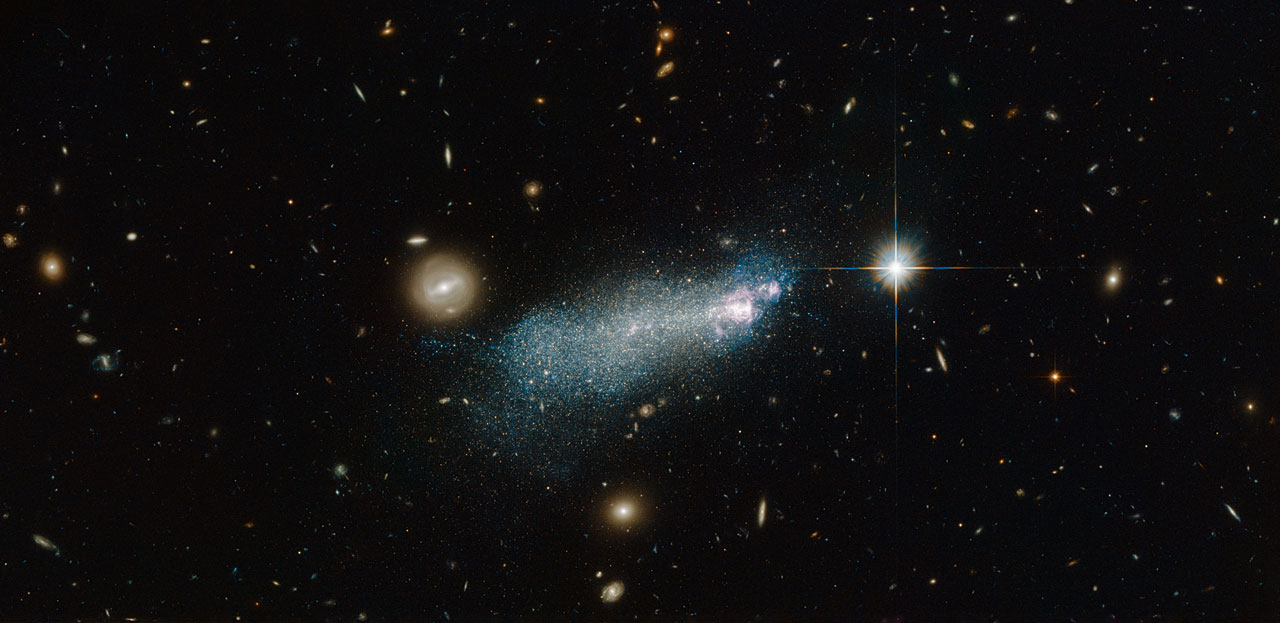
The bright streak of glowing gas and stars in this NASA/ESA Hubble Space Telescope image is known as PGC 51017, or SBSG 1415+437. It is a type of galaxy known as a blue compact dwarf. This particular dwarf is well studied and has an interesting star formation history. Astronomers initially thought that SBS 1415+437 was a very young galaxy currently undergoing its very first burst of star formation, but more recent studies have suggested that the galaxy is in fact a little older, containing stars over 1.3 billion years old. Starbursts are an area of ongoing research for astronomers — short-lived and intense periods of star formation, during which huge amounts of gas within a galaxy are hungrily used up to form newborn stars. Read more: 1.usa.gov/1ExsNx0 Credit: ESA/Hubble and NASA Acknowledgement: Alessandra Aloisi (STScI) and Nick Rose NASA image use policy. NASA Goddard Space Flight Center enables NASA’s mission through four scientific endeavors: Earth Science, Heliophysics, Solar System Exploration, and Astrophysics. Goddard plays a leading role in NASA’s accomplishments by contributing compelling scientific knowledge to advance the Agency’s mission. Follow us on Twitter Like us on Facebook Find us on Instagram
This particular celestial object, Hubble Sees an Intriguing Young-Looking Dwarf Galaxy, was captured by NASA's deep space observatories. While its specific historical mythology remains a mystery, objects of this type are crucial for our understanding of cosmic evolution and stellar life cycles.
To observe phenomena similar to this, we recommend using high-contrast filters and a motorized equatorial mount.
Discover nebula-themed journey sites designed for peaceful observation.
Japan, Ogasawara
Stargazing Tour - Observe the best starry sky in Japan, Ogasawara!
ExploreNew Zealand
Small-Group Refined Experience - Stargazing English Tour in Tekapo | New Zealand
ExploreHawaii
Hawaii Big Island: Mauna Kea Stargazing Half-Day Tour with Transfer Service in Waikoloa, Kona, and Hilo
Explore
NASA often uses 'false color' techniques. Scientists map invisible wavelengths (like infrared) or specific gases to visible colors (red, green, blue) to highlight the nebula's structural details.
While some bright nebulas are visible with entry-level telescopes, capturing these stunning details usually requires deep-sky astrophotography equipment and long exposures.


