
from US$22.21
Japan, Ogasawara
Stargazing Tour - Observe the best starry sky in Japan, Ogasawara!
Explore
Explore the profound quiet of the universe through NASA's high-resolution archives. Perfect for your stargazing journey.
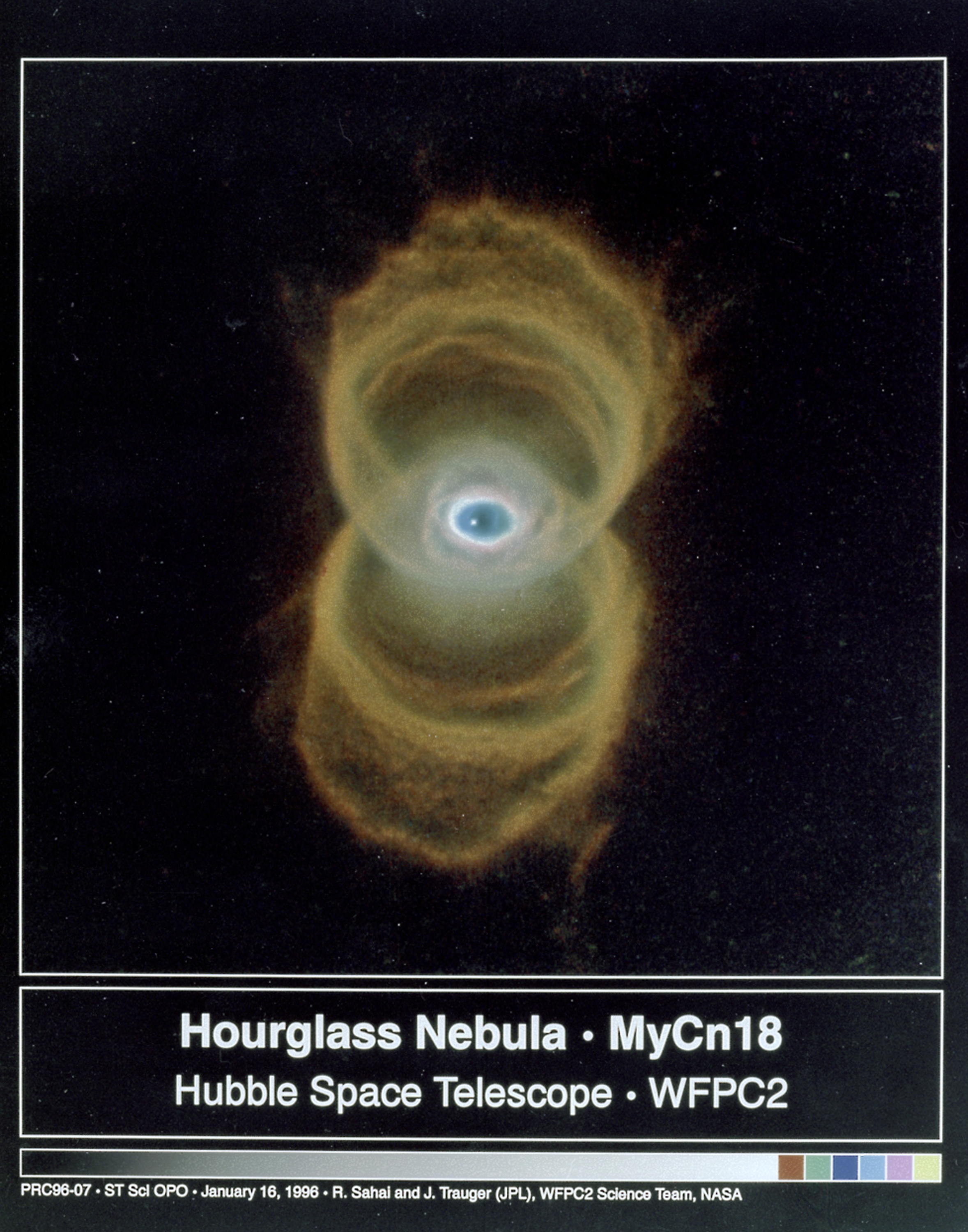
Taken by the Wide Field Planetary Camera 2 (WFPC2) of the Hubble Space Telescope (HST), this image of MyCn18, a young planetary nebula located about 8,000 light-years away, reveals its true shape to be an hourglass with an intricate pattern of "etchings" in its walls. The arc-like etchings could be the remnants of discrete shells ejected from the star when it was younger, flow instabilities, or could result from the action of a narrow beam of matter impinging on the hourglass walls. According to one theory on the formation of planetary nebulae, the hourglass shape is produced by the expansion of a fast stellar wind within a slowly expanding cloud, which is denser near its equator than near its poles. Hubble has also revealed other features in MyCn18 which are completely new and unexpected. For example, there is a pair of intersecting elliptical rings in the central region which appear to be the rims of a smaller hourglass. This picture has been composed from three separate images taken in the light of ionized nitrogen (represented by red), hydrogen (green) and doubly-ionized oxygen (blue). The results are of great interest because they shed new light on the poorly understood ejection of stellar matter which accompanies the slow death of sun-like stars. An unseen companion star and accompanying gravitational effects may well be necessary in order to explain the structure of MyCn18. The Marshall Space Flight Center (MSFC) had responsibility for design, development, and construction of the HST.
Discover nebula-themed journey sites designed for peaceful observation.
Japan, Ogasawara
Stargazing Tour - Observe the best starry sky in Japan, Ogasawara!
ExploreNew Zealand
Small-Group Refined Experience - Stargazing English Tour in Tekapo | New Zealand
ExploreHawaii
Hawaii Big Island: Mauna Kea Stargazing Half-Day Tour with Transfer Service in Waikoloa, Kona, and Hilo
Explore
NASA often uses 'false color' techniques. Scientists map invisible wavelengths (like infrared) or specific gases to visible colors (red, green, blue) to highlight the nebula's structural details.
While some bright nebulas are visible with entry-level telescopes, capturing these stunning details usually requires deep-sky astrophotography equipment and long exposures.


